Why an Acre of Rocky Point Land Can Cost $9,000 or $60,000, and What the Gap Actually Means
August 13, 2026
August 13, 2026
Two properties for sale in Rocky Point right now make the same point from opposite directions. One is a 135-acre parcel with paperwork already in place, the kind that usually takes months to assemble. The other is 25 acres of mature loblolly pine, marketed for hunting and timber value, sitting outside the area's extraterritorial jurisdiction with no soil work done at all. The first property is more than five times larger. Acreage alone won't tell you which one is priced higher per acre. Permit status will.
Divide either by its acreage and you land on a number that means almost nothing on its own. What actually separates a cheap per-acre listing from an expensive one in this market isn't location within Rocky Point. It's how much of the invisible paperwork, wells, septic permits, and utility access, has already been done, and that's the part the median price on a portal search never tells you.
If you pull per-acre figures for Pender County land right now, you'll find a spread wide enough to make you wonder if the data is broken. It isn't. It's telling you something real about what's actually for sale.
| What's being measured | Per-acre figure | What it actually reflects |
|---|---|---|
| Recently closed land sales, countywide | $9,062 median per acre | Mostly larger, undeveloped tracts sold for timber, farmland, or long-term hold |
| Active land listings, countywide | $61,855 average per acre | Smaller, near-ready lots pull the average up sharply |
| Active land listings, Rocky Point specifically | $20,709 average per acre | A mix of raw acreage and infrastructure-ready parcels, sitting in between |
The gap between the low and high figures isn't a pricing error. It's the difference between land that still needs everything (a soil evaluation, a well, a septic permit, road access) and land where someone already paid for that groundwork and is passing the cost along in the sale price. A small lot with utilities at the line and a bedroom permit already in hand can price out higher per acre than a much larger timber tract, even a few roads apart.
This matters more than it sounds like it should, because a buyer comparing two land listings by price alone might assume the cheaper one is simply the worse deal. Sometimes it is. Just as often, it's raw ground waiting for the buyer to do the work the other seller already finished.
Rocky Point sits far enough from the immediate coastline that municipal sewer isn't standard the way it is closer to Wilmington's core. Most residential building here still depends on private well and septic, which means the real gating item on any parcel isn't zoning or setback rules. It's whether the soil underneath has already been tested and approved.
That 135-acre parcel is worth sitting with for a second, because it shows how completed groundwork can affect a land price, regardless of how many acres come with it. None of that shows up as a separate line item on the listing. It's baked into the number.
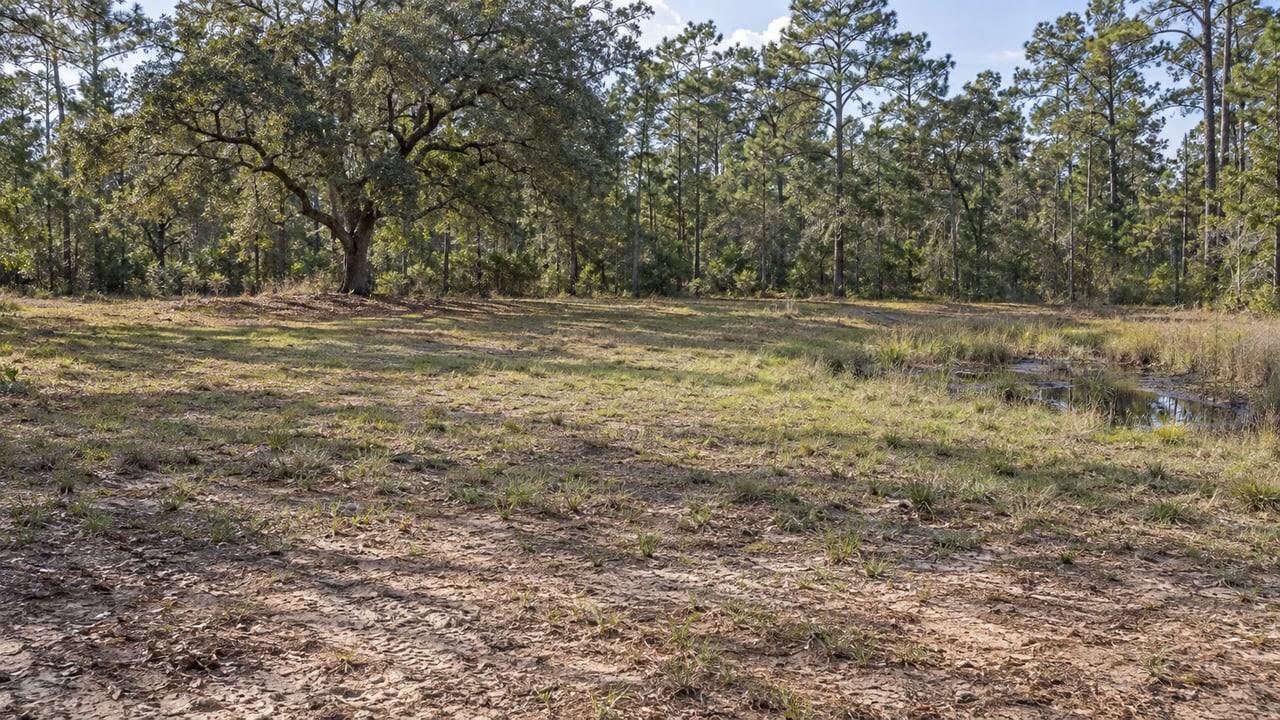
Compare that to the 25 acres of loblolly pine marketed for hunting and timber value. Nobody has done the soil work because nobody needed to for that use. That is part of why land like this trades on timber value rather than buildable value. The land is priced for what it is right now, not what it could become, regardless of whether the soil underneath would actually perc just fine.
According to Septic and Well, North Carolina doesn't require a seller to hand over a septic evaluation before selling undeveloped land. That responsibility sits entirely with the buyer, which means the single most important document in a Rocky Point land purchase is often one nobody mentions until due diligence is already underway.
The document that matters is called an Improvement Permit. Pender County's Environmental Health Division issues it after a soil evaluation, and it spells out exactly what kind of system the site can support, what the required setbacks are, and where a repair field could go if the first one ever fails. The county's standard evaluation typically takes somewhere between four and eight weeks. A private licensed soil scientist can turn the same evaluation around in seven to fourteen days, usually for $1,500 to $2,500. For a buyer with a due diligence window shorter than a month, the faster turnaround may offer the only realistic path to closing on time.
North Carolina also sizes septic systems at 120 gallons per day per bedroom. Pender County now runs this whole process through its Pender Online Resource Tool, and the county's Environmental Health Division handles the soil testing and permitting directly, but buyers should still track down the paperwork themselves.
Not every acre in Rocky Point is stuck with well and septic indefinitely. The area sits inside the Rocky Point/Topsail Water and Sewer District, one of six districts Pender County Utilities manages for more than 11,000 residents across the county. State water infrastructure filings show this specific district has been the subject of a reverse osmosis treatment plant project sized to serve roughly 7,700 people, built with new groundwater wells and a substantial length of new waterline designed to carry capacity further into the growth corridor.
None of that means every parcel in Rocky Point is on county water today. It means the district's boundary is a real line on a map, and which side of it a given parcel falls on is worth more to its long-term value than almost anything else about the property. A lot inside the service area with a path to a water tap is a fundamentally different asset than a lot a few hundred yards away that depends on a private well for the life of the house.
On July 31, 2026, Port City Daily reported that Bill Clark Homes has filed a rezoning application for 1,023 single-family homes on 630 acres near the intersection of N.C. Highway 210 and Pine Village Drive in Rocky Point. The land is currently zoned rural agricultural, and the developer needs a conditional zoning district approved before anything moves forward. County planning staff has recommended approval, and the application was scheduled to go before the Pender County Planning Board in early August, with commissioners holding final say after that.
Construction, if approved, is expected to run from 2028 through 2035. Nearly 40 percent of the property, about 253.52 acres, would go into a conservation easement covering uplands and floodplain, which county staff notes is meant to let existing wildlife corridors keep functioning even as the rest of the tract builds out.
For buyers weighing long-term growth in the area, the filing puts a proposed development on the map. Land near that stretch of NC-210 could be bought ahead of a long, slow-moving wave, so anyone buying acreage in the corridor should weigh the possibility of a multi-year transition rather than expect an immediate change in the area.
WECT reported that Pender County completed its first property tax reassessment in seven years this spring, resetting values to fair market value as of January 1, 2026. County Manager Colby Sawyer confirmed that across roughly 55,000 parcels, 91 percent increased in value and 9 percent decreased, though a higher assessed value doesn't automatically mean a higher tax bill since the final number depends on the rate the county sets later in its budget process.
That reassessment landed in April, just months before news of the 630-acre rezoning became public. Two separate mechanisms are recalibrating what Rocky Point land is worth right now, on two different timelines, for two different reasons. The tax assessment reset is backward-looking, catching the county up on seven years of growth it hadn't yet accounted for. The rezoning pipeline is forward-looking, pricing in a development wave that won't finish construction until sometime in the 2030s. A buyer evaluating a parcel today is really looking at the overlap of both.
Before writing an offer on acreage in this area, it's worth confirming a short list of specifics rather than relying on the per-acre number alone:
Pender County recently launched a redesigned GIS Parcel Viewer built for exactly this kind of research, giving buyers and real estate professionals a faster way to pull up parcel boundaries, ownership history, and property details before making an offer.
The per-acre number on a listing is a starting point, not an answer. What it actually reflects is how much work has already been done on that ground, and how much is still left for you to finish.
If you're weighing a parcel in Rocky Point against options elsewhere in Southeast NC, Shannon Bowers can walk through what a specific piece of land is really priced for, permit status included, before you write an offer. Let's Connect.
This article is general information, not legal, tax or financial advice. Consult a qualified professional about your situation.
Stay up to date on the latest real estate trends.
As a lifelong resident of Southeast North Carolina, Shannon brings firsthand knowledge of the communities she serves along with a commitment to personalized service and responsive communication. Whether you're buying or selling, you can count on dedicated guidance, honest advice, and support tailored to your unique real estate goals.