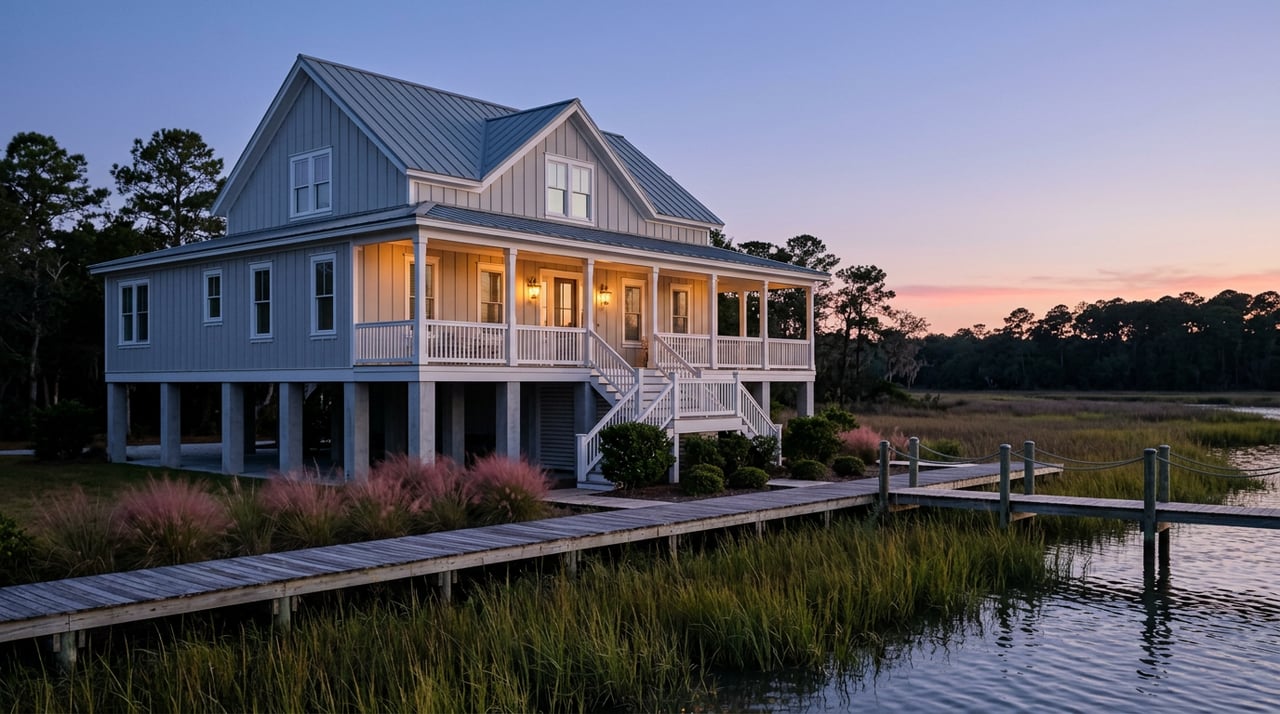
Surf City NC Mainland Development: What Growth Means for Buyers
September 24, 2026
September 24, 2026
If you are comparing Surf City listings side by side, the address matters more than the price. Two homes can carry the same "Surf City, NC" listing and sit in entirely different growth stories: one on a barrier island that is, for practical purposes, out of room, and one on a mainland corridor that town planners have formally designated a growth zone and are actively building out. Treating those as the same market is the mistake. Understanding the split is the advantage.
Surf City sits on Topsail Island, connected to the mainland by a single fixed-span bridge over the Intracoastal Waterway that replaced the town's old swing bridge in 2018. Everything on the island side of that bridge is bounded by the ocean on one edge and the waterway on the other. There is no meaningful undeveloped acreage left to annex or rezone into new subdivisions. What exists, exists. New supply on the island comes almost entirely from teardown-rebuilds and infill, not from new tracts of land.
The mainland side is a different story entirely. Surf City has annexed and grown its mainland footprint for years, and the town's own planning documents now refer to the stretch along US 17, NC 210, and NC 50 as a Job Growth Corridor. The Surf City Planning Board's 2025-2026 initiatives explicitly call for evaluating future land use "particularly looking at Job Growth Corridors along US17/NC210 as well as transportation-based standards for NC50." That's not marketing language. That's the town telling you, in a public planning document, where it expects growth to land.
Three separate projects moved through Surf City's council in roughly a seven-month span, and together they show how fast the mainland side is filling in.
None of that is happening on the island. All of it is happening within a few miles of each other on the mainland corridor.
Here is the part that doesn't show up on a listing sheet: getting a rezoning approved in Surf City does not guarantee a developer can build at full scale, because the town's wastewater treatment capacity is allocated by policy, not by demand. Surf City adopted a wastewater allocation policy in December 2024 that sets hard percentages: non-residential development cannot receive less than 30 percent of the town's total treatment capacity, and residential development cannot exceed 50 percent. Priority within that framework goes to what the policy calls quality development projects, mixed-use developments, and major employers, which is exactly the kind of project the Medlin and Tidal sites represent.
That policy came up directly during the Dandelion Lane hearing, when council members pressed on traffic and sewer capacity before voting. Mayor Pro Tem Jeremy Shugarts asked planners a pointed question about the site's proximity to Cape Fear Community College, as reported by Port City Daily:
"How many students are going to go through there per day?"
The traffic impact analysis for the Tidal Development site later showed peak-hour trips exceeding 100 vehicles, which forced changes to the site plan before final approval. Traffic and sewer capacity, not zoning designation, are the actual gatekeepers on how fast this corridor can absorb new commercial square footage.
The town is investing to keep pace. Its 2025-2026 strategic performance report lists a new high-capacity well, rated at 1,000 gallons per minute or more, as fully funded and, at the time, on track to come online by the end of 2025, alongside a planned expansion study for the existing water treatment plant tied directly to projected population growth. A new multi-use path segment along NC-210, running from Magnolia Reserve to the Surf City Mainland Fire Department, is expected to finish by the end of 2026. Infrastructure is catching up to the zoning approvals, but it is catching up on its own timeline, not the developer's.
For a buyer weighing an island property against a mainland one, the practical differences go beyond distance to the sand.
None of this makes one side of Surf City better than the other. It makes them different products serving different priorities, and buyers who understand the split can price that difference into their decision instead of discovering it after closing.
Is mainland Surf City still technically part of the town, or is it a separate area? It's part of Surf City. The town has annexed mainland acreage over time, which is why properties on both sides of the Intracoastal Waterway carry the same municipal address even though they sit in very different physical settings.
Why can't the island add new subdivisions to meet demand the way the mainland is? The island's buildable land is fixed by its geography, bounded by the ocean and the waterway with no adjacent undeveloped tracts to annex. Growth there comes from renovating or rebuilding existing lots, not from new land coming online.
How long will the mainland build-out actually take? The Medlin Mixed-Use project alone is projected to take five to ten years to fully build out once construction starts. The Tidal Development site is expected to begin construction within about 12 months of clearing remaining permitting, including sign-off from the NC Department of Environmental Quality.
Does buying on the mainland mean giving up beach access? Not necessarily. Mainland Surf City properties are typically a short drive from the same bridge and beach access points that island residents use, and the corridor's growth is aimed at services and housing, not at replacing the beach itself.
Whether you're weighing a fixed-supply island lot or a new-construction option on the growth corridor, the details in the town's own planning and utility records matter more than the listing description. If you want help sorting through what a specific Surf City address actually means for your plans, Shannon Bowers is happy to walk through it with you. Let's Connect.
This article is general information, not legal, tax or financial advice. Consult a qualified professional about your situation.
Stay up to date on the latest real estate trends.

As a lifelong resident of Southeast North Carolina, Shannon brings firsthand knowledge of the communities she serves along with a commitment to personalized service and responsive communication. Whether you're buying or selling, you can count on dedicated guidance, honest advice, and support tailored to your unique real estate goals.